BOOK
From Strategy Design to Live Execution
You will build a complete algorithmic trading system — from data ingestion and signal generation through backtesting, risk management, and live execution.
This book teaches you how to build, test, and operate a complete algorithmic trading system in Python — from data ingestion through execution and monitoring. By the end, you will have a production-oriented trading framework with modular data feeds, a strategy engine, a backtester, risk controls, an execution layer, and a monitoring stack.
Built for
A practical guide for Python developers who want to build real automated trading systems, not just run notebooks. The reader is comfortable writing production code and wants to understand the full pipeline from data to execution.
What makes it useful
You will build a complete algorithmic trading system — from data ingestion and signal generation through backtesting, risk management, and live execution — using Python and battle-tested open-source libraries.
THE DIFFERENCE
A production-oriented Python trading framework with modular data feeds, strategy engine, backtester, risk controls, execution layer, and monitoring stack.
Apply the practical framework in The Trading System Blueprint - defines the end-to-end trading architecture and the contracts between data, strategy, risk, execution, and monitoring..
Apply the practical framework in Signal Design and Indicator Engineering - turns raw data into reproducible signal components rather than dashboard decoration..
Apply the practical framework in Transaction Costs, Slippage, and Execution Reality - forces strategy logic to survive realistic frictions before live deployment..
THE FULL BRIEF
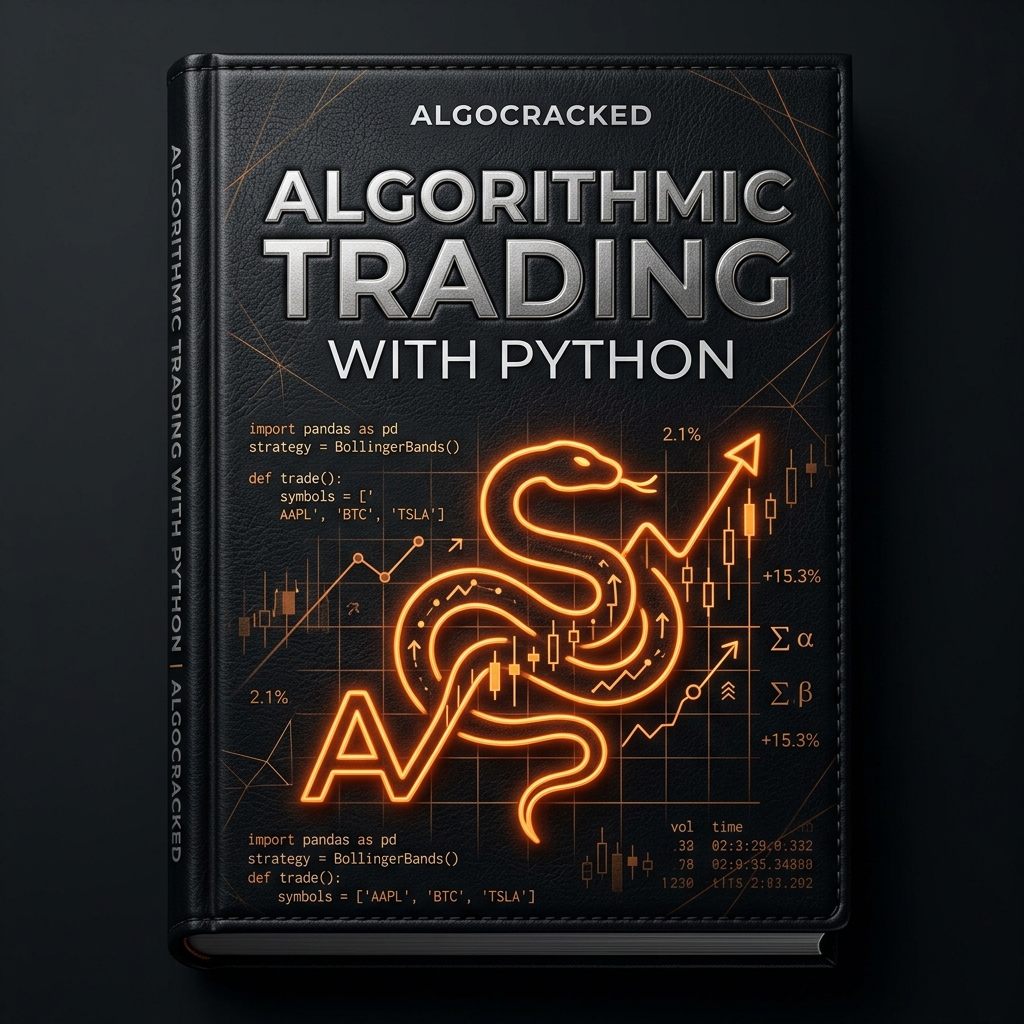
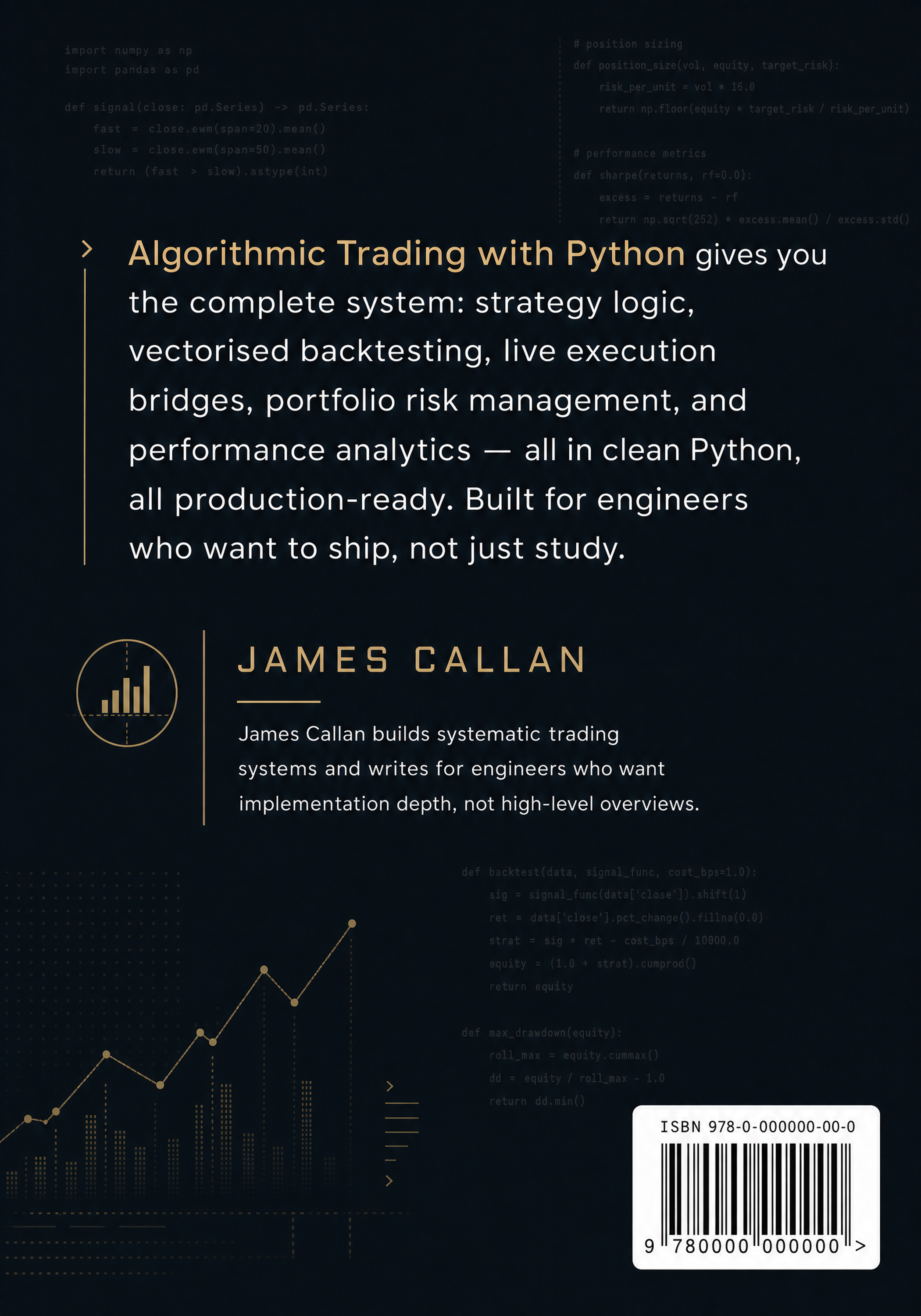
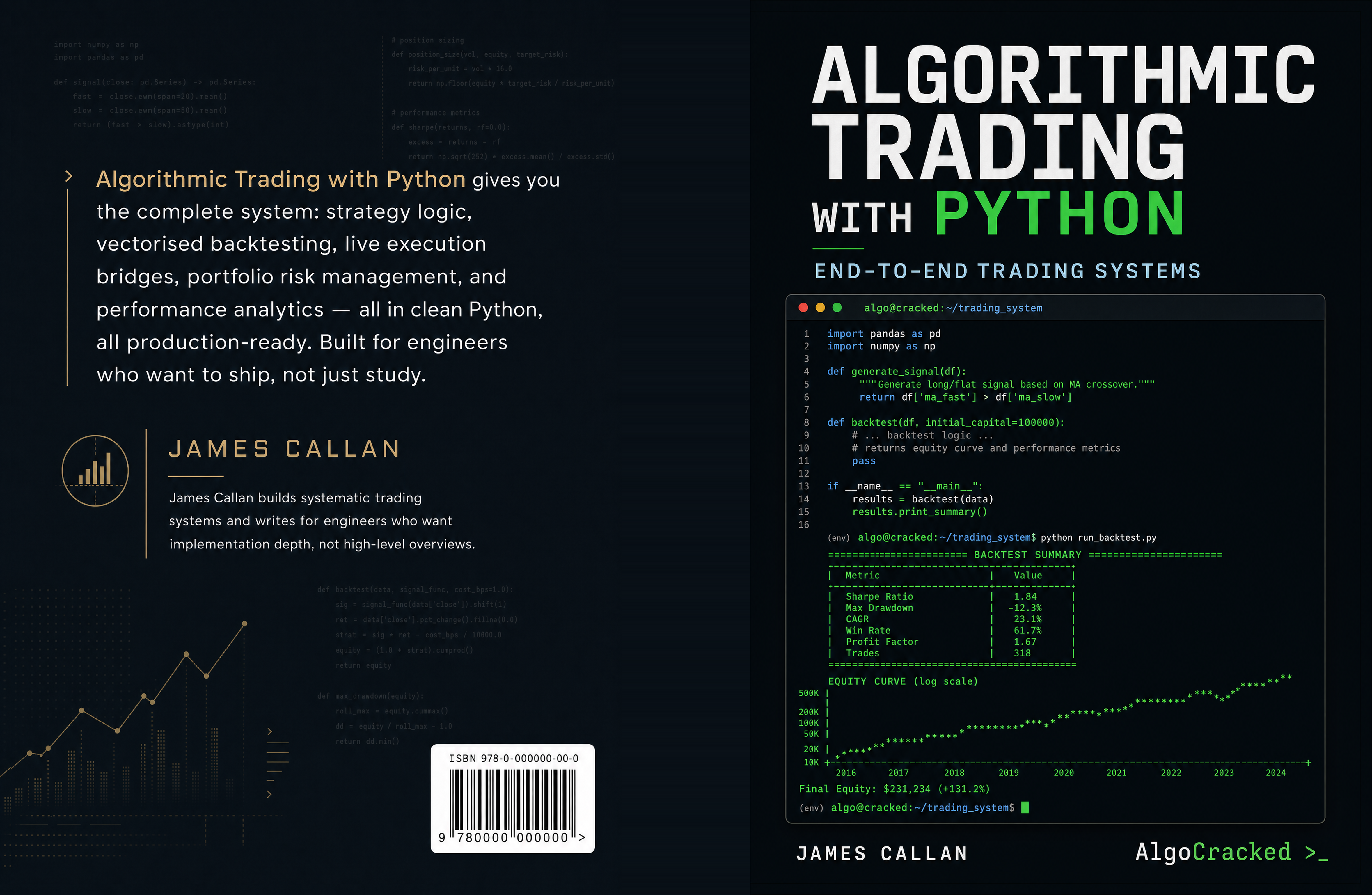
This book teaches you how to build, test, and operate a complete algorithmic trading system in Python — from data ingestion through execution and monitoring. By the end, you will have a production-oriented trading framework with modular data feeds, a strategy engine, a backtester, risk controls, an execution layer, and a monitoring stack.
This book teaches you how to build, test, and operate a complete algorithmic trading system in Python — from data ingestion through execution and monitoring. By the end, you will have a production-oriented trading framework with modular data feeds, a strategy engine, a backtester, risk controls, an execution layer, and a monitoring stack.
What this book gives you: You will build a complete algorithmic trading system — from data ingestion and signal generation through backtesting, risk management, and live execution — using Python and battle-tested open-source libraries.
What you will be able to do:
A production-oriented Python trading framework with modular data feeds, strategy engine, backtester, risk controls, execution layer, and monitoring stack.
Apply the practical framework in The Trading System Blueprint - defines the end-to-end trading architecture and the contracts between data, strategy, risk, execution, and monitoring..
THE TABLE OF CONTENTS
defines the end-to-end trading architecture and the contracts between data, strategy, risk, execution, and monitoring.
teaches the reader how to ingest, clean, store, and validate market data for trading use.
turns raw data into reproducible signal components rather than dashboard decoration.
builds a realistic backtesting engine that mirrors live trading flows.
Delivered instantly after checkout.
EPUB
Delivered instantly after checkout.
Free preview
Read before you commit.
A production-ready algorithmic trading framework with modular data feeds, strategy engine, backtester, risk manager, and broker connectivity layer.
Apply the practical framework in Broker Connectivity and Paper Trading - connects the research stack to external APIs and controlled live-like testing..
Apply the practical framework in Regime-Aware Backtesting and Stress Testing - teaches regime detection, walk-forward analysis, volume-dependent slippage models, survivorship bias correction.
complements event-driven simulation with faster research loops and disciplined evaluation.
forces strategy logic to survive realistic frictions before live deployment.
makes sizing, exposure limits, and portfolio construction explicit parts of the system.
connects the research stack to external APIs and controlled live-like testing.
turns the framework into an operating trading application with observability.
closes the book with review loops, incident handling, and strategy lifecycle control.
teaches regime detection, walk-forward analysis, volume-dependent slippage models, survivorship bias correction, stress testing across historical crises (2008, March 2020, 2022 QT), and out-of-sample validation discipline.
builds the execution layer for routing orders across multiple venues with best-execution logic, venue-specific fill models, cross-venue position aggregation, and latency-aware order routing in Python.
teaches adversarial thinking for algorithmic traders including front-running detection, liquidity withdrawal scenarios, market manipulation regulations (spoofing, layering, quote stuffing), and compliance monitoring infrastructure.
Instant Access
Available immediately after purchase
Secure Checkout
Payments processed by Stripe